
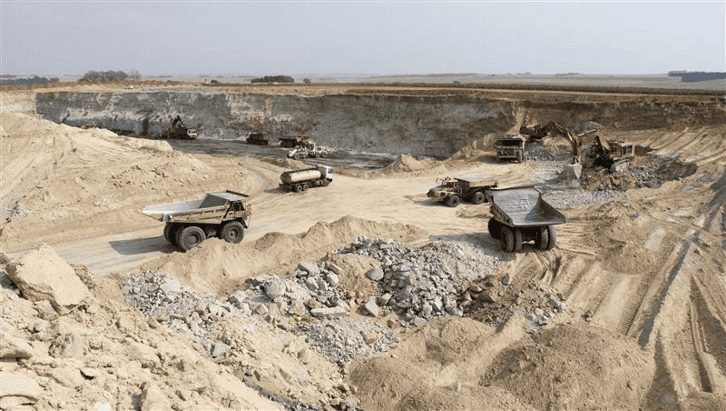
Mining workforces are mobile. Operators move between sites, between companies, between contracts. They don’t arrive untrained; they arrive differently trained.
One site teaches priority rules in one way. Another has a different approach. An operator with 15 years’ experience might have five different sets of habits built across five different operations. The challenge isn’t a lack of training. It’s a lack of consistency.
When your workforce brings varied prior experience to a single set of site-specific rules, the gap isn’t knowledge; it’s alignment. And alignment takes more than a slide deck and an induction quiz.
So, what does it take to build training that creates genuine consistency?
The Limits of Traditional Training
Consider something as fundamental as priority rules at mine-site intersections. Good operations teach structured approaches, rules like the 50/20/10 method that train operators to scan for hazards well before they reach an intersection. This isn’t about reactive, split-second decisions. It’s about preparation.
But when a new operator arrives from another site, they may have learnt a completely different set of rules. A different scanning approach. Different communication protocols. Their instincts are trained, just trained differently.
Classroom training can explain the new rules. What it can’t do is retrain established habits or build the spatial, reflexive familiarity needed to apply site-specific procedures consistently under real operational pressure.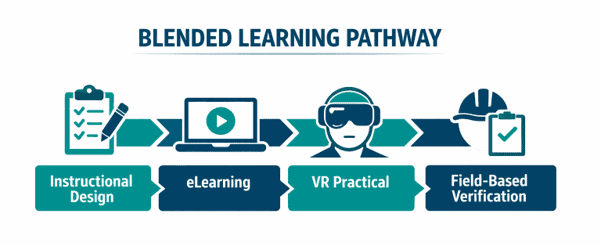
What Blended Learning Actually Means
Blended learning isn’t a new concept, but it’s often misunderstood. It’s not simply offering both online and face-to-face training. It’s a deliberate design approach that matches the right delivery method to the right learning objective and sequences them, so each stage builds on the last.
For high-risk training, a well-designed blended approach follows four stages:
Stage 1: Instructional Design — The Foundation
Before any content is built, someone needs to ask the right questions. What do learners actually need to know? What existing training materials are worth keeping? What does competency look like for this specific site?
A skilled Instructional Design (ID) team works with subject matter experts to audit existing content, define measurable learning outcomes, and design a training pathway that’s purposeful and connected to on-site performance. Most organisations already have a wealth of training content; the ID process makes sense of what exists and fills the gaps.
Stage 2: eLearning — The Knowledge
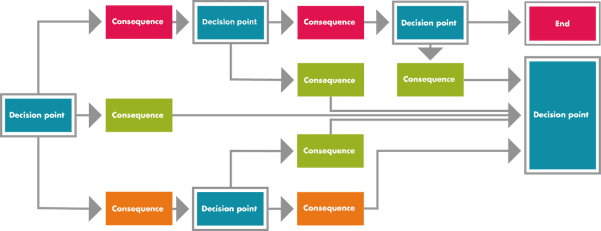
With the pathway designed, eLearning modules deliver the theoretical foundation. The best modules are outcome and scenario-based, not slide-based. Learners make decisions, see consequences, and engage with content that mirrors real situations.
For spatial concepts, such as when a vehicle approaches an intersection, 2D and 3D animations embedded directly within the module make abstract rules concrete. Learners see the geometry, the timing, and the structured approach playing out dynamically.
Stage 3: VR — The Practice
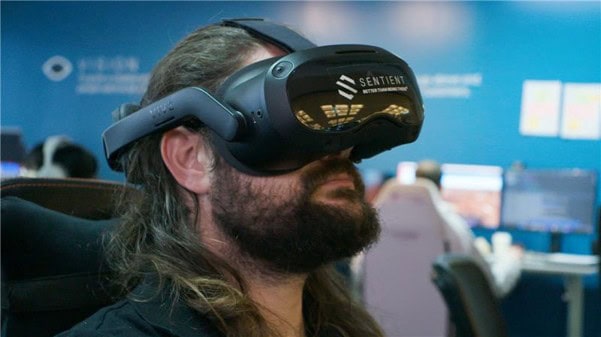
Once learners have the theoretical grounding, they step into a virtual reality environment and apply that knowledge under realistic conditions. VR doesn’t just test knowledge; it builds the kind of reflexive, embodied familiarity that classroom assessments can’t create.
Instructors can observe, assess, and debrief. Learners build confidence through repeated, safe practice with their site’s specific procedures, not someone else’s.
Stage 4: Field-Based Verification — The Real Thing
On-site, the learner is assessed performing the task under real operational conditions, supervised, observed and signed off. This is a critical part of any mining training pathway, and blended learning doesn’t replace it; it enhances it.
Because learners arrive at this stage already familiar with the site’s rules, having practised them in both eLearning and VR, they’re not applying new knowledge for the first time in a live environment. This means reduced time to competency during field verification, faster progression to production, and increased safety through prior familiarisation.
Why the Sequence Matters
Each stage is valuable on its own. But the real power comes from the sequence. Skip the ID stage, and your content may be poorly structured. Skip the eLearning, and learners enter VR without theoretical grounding. Skip the VR, and the theory never gets tested under pressure. And without strong preparation in stages 1–3, field-based verification takes longer and carries more risk.
The blended model doesn’t replace on-the-job training. It makes it more effective by ensuring workers arrive better prepared.
Where to Start
If your team trains for high-risk environments and you’re finding that varied prior experience creates consistency challenges, blended learning is worth exploring. It doesn’t require starting from scratch, as most organisations have more training content than they realise. It just needs restructuring, redesigning, and connecting to the right delivery methods.
If you’d like to explore what a blended learning approach could look like for your operation, get in touch with our team today.